

Move
Process


GOALS
The move process (address change via customer portal) showed a low conversion rate. Our goal was to significantly improve performance through targeted UX measures.


Context
The process included various friction points. Using qualitative analysis, user testing, and a focused redesign, we optimized the flow and achieved a significant boost in conversion.


METHODS
- Figma Prototyping
- User Testing
- Decibel Session Analysis
- A/B Testing


Swisscom

UX Strategist & Designer
Learnings
- I learned that session recordings (e.g. with Decibel) are a powerful tool to uncover real user issues.
- I learned how valuable it is to leverage familiar interaction patterns (like Google Maps input) as UX best practices.
- I learned that mobile-first thinking not only improves screen usability, but also simplifies the overall UX logic.

Phase 1: Research
Problem Areas
- The interface was built solely for desktop – no mobile optimization
- The content structure didn’t match user expectations
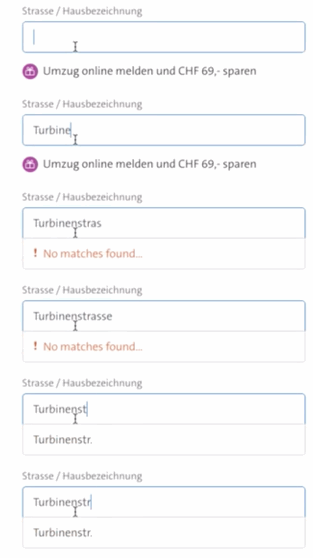
- The address input field was error-prone and rigid (e.g. no mapping for abbreviations like “Str.”)

Phase 2: Concept & Prototyping
Implemented Improvements
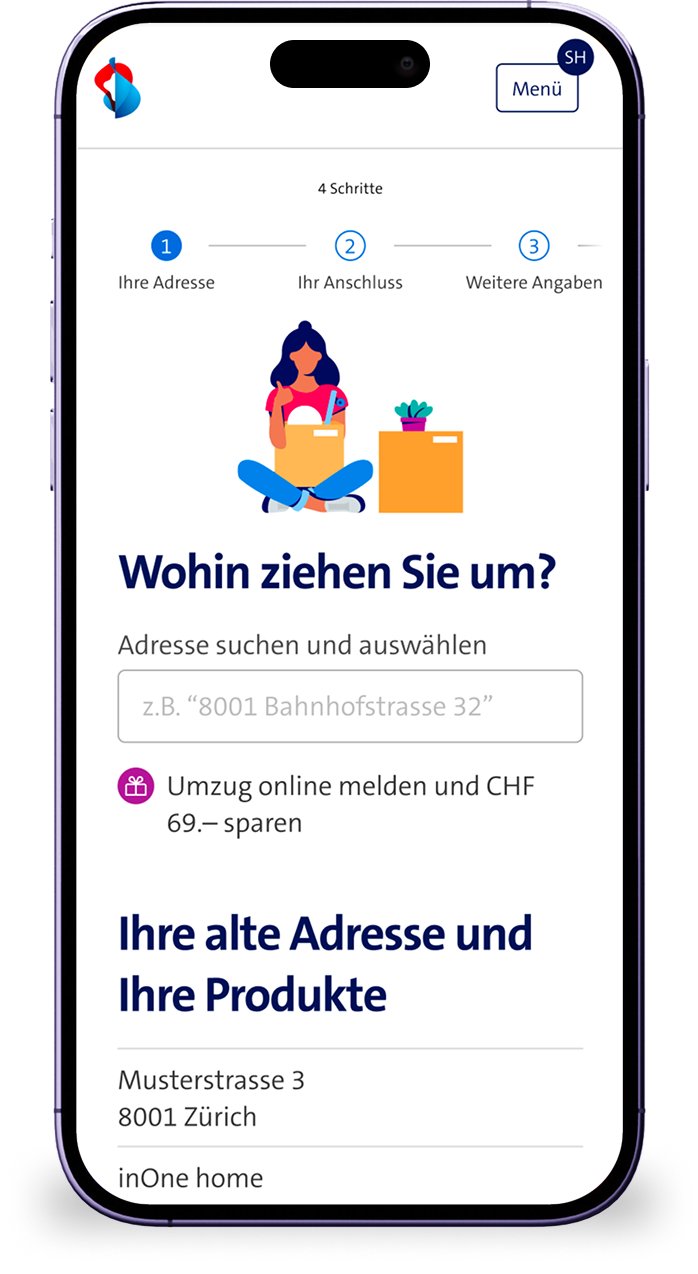
- Mobile First – The redesigned flow is optimized for mobile use
- Clear structure & simplified wording – better orientation and reduced cognitive load
- Smart single-line address input – Users can enter addresses freely, like in Google Maps – regardless of format or order
Behind the scenes, a smart mapping system handles abbreviations, synonyms, and multilingual inputs automatically.

Phase 3: Testing & Delivery
Validation & Launch
The updated flows were validated through A/B testing. Additional backend optimizations supported the overall process.
Outcome: All measures combined led to a strong double-digit increase in conversion rate for the move process.
NEXT PROJECT

BACK TO MY PROJECTS
HOME
MY STORY
MY PROJECTS
CONTACT ME
Move
Process
GOALS
The move process (address change via customer portal) showed a low conversion rate. Our goal was to significantly improve performance through targeted UX measures.
Context
The process included various friction points. Using qualitative analysis, user testing, and a focused redesign, we optimized the flow and achieved a significant boost in conversion.
METHODS
- Figma Prototyping
- User Testing
- Decibel Session Analysis
- A/B Testing
Swisscom
UX Strategist & Designer
Learnings
- I learned that session recordings (e.g. with Decibel) are a powerful tool to uncover real user issues.
- I learned how valuable it is to leverage familiar interaction patterns (like Google Maps input) as UX best practices.
- I learned that mobile-first thinking not only improves screen usability, but also simplifies the overall UX logic.
Phase 1: Research
Problem Areas
- The interface was built solely for desktop – no mobile optimization
- The content structure didn’t match user expectations
- The address input field was error-prone and rigid (e.g. no mapping for abbreviations like “Str.”)
Phase 2: Concept & Prototyping
Implemented Improvements
- Mobile First – The redesigned flow is optimized for mobile use
- Clear structure & simplified wording – better orientation and reduced cognitive load
- Smart single-line address input – Users can enter addresses freely, like in Google Maps – regardless of format or order
Behind the scenes, a smart mapping system handles abbreviations, synonyms, and multilingual inputs automatically.
Phase 3: Testing & Delivery
Validation & Launch
The updated flows were validated through A/B testing. Additional backend optimizations supported the overall process.
Outcome: All measures combined led to a strong double-digit increase in conversion rate for the move process.
BACK TO MY PROJECTS
NEXT PROJECT